Jonathan Glazer's latest film is a deliciously creepy, almost comically absurd foray into horror. It's kind of both brilliantly clever and unbelievably silly.
There are films that we say we want to see; others that we say we ought to see. Sometimes, these two motives coalesce. More often that not, however, the prospect of a weighty, historical drama with a personal tale of abduction, betrayal, and persecution at its core is a daunting one. Steve McQueen's 12 Years A Slave, as its title suggests, really is a gruelling ride.
Based on actual memoirs, the narrative centres on the harrowing experiences of Solomon Northup, a New York-born musician who was taken hostage and sold into slavery for over a decade in the mid-nineteenth century. Northup is astutely and agonisingly underplayed by Chiwetel Ejiofor, who uses physical gestures and silence to convey the slave's reality as one of slow, monotonous horror. He is joined by much touted newcomer Lupita Nyong'o, who gives a dignified and restrained performance as the shockingly abused Patsey.
Slavery, despite its impact on our historical consciousness, is rarely tackled by filmmakers, perhaps because it has left such a complex and unresolved legacy in contemporary race relations. As director, McQueen crucially avoids the exuberant, slapstick violence of a film like Quentin Tarantino's Djano Unchained, using much more subtly affecting strategies to gradually construct a picture of unrelenting suffering. His camera doesn't look away when the lashes of Michael Fassbender's slave owner seem to reach a climax. Instead, he holds his gaze, disregarding the traditional pattern of pain followed by a release. There is no way out here, for the victim or the viewer.
The problem with McQueen's fidelity to cinematic realism is that, as the violence goes on, the experience becomes unbearable and, subsequently, numbing. There is no antidote, as perhaps there shouldn't be for a crime still awaiting atonement. But this makes for a very difficult two and a half hours in the cinema, which is not helped by the fact that Northup's personal history is somewhat underdeveloped. I thought that the depiction of his family home in New York merited more attention, as it would have given his escape route a more concrete endpoint: a destination the audience could have imagined with him as a counter to the hell of the deep South. Moreover, it may be a beautifully shot film, born of McQueen's aesthetically-attuned artist's eye, but the script seemed fairly uninspired, using dialogue only to generate specific incidents or create moments of visual tension.
Whilst undoubtedly captivating, perhaps in the sense that it holds its viewers captive as much as it commands their attention, 12 Years A Slave is a devastating film. Its shockwaves were felt long after the credits rolled onto the screen and people milled around outside the cinema, already trying to forget. A towering visual achievement; it is almost unwatchable.
And hustle it does, in more ways than one. This is a prime example of a film succeeding spectacularly on its own steam. It has the golden cast - Christian Bale, Amy Adams, Jennifer Lawrence, and Bradley Cooper - and the writer-director of the moment, David O. Russell, who has pulled it off again one year after Silver Linings Playbook swept the awards season. American Hustle is a glitzier, trashier version of Silver Linings, using the same combination of cynicism and saccharine screwball to charm audiences into thinking it might actually have something to say.
This may sound unfair, but a film with ten (!) Academy Award nominations should surely be held to a higher standard than most. And, in some respects, it does have a lot going for it. The first ten minutes, in which Christian Bale's balding, bloated con-artist, Irving Rosenfeld, reconstructs his hairpiece are brilliantly played out with painstaking precision. The scene makes a strong statement about Hustle's intentions: get the superficial stuff right, and the rest will follow. But that's where the real problem lies. This is a film full of wigs and mirrors, where the costumes are not just the disguise but the substance itself.
Oh, but what wigs! Bradley Cooper apparently spent more time in hair and makeup than any other cast member and it certainly shows in his perfectly sculpted 70's curls. He plays FBI agent Richie DiMaso, who attempts to carve a career for himself by playing ball with the very people he is supposed to be incarcerating. His efforts to ensnare local politician Carmine Polito (a subtle turn from Jeremy Renner) lead to a convoluted double bluff, in which Rosenfeld and his partner Sydney Prosser (Adams) become both puppets and puppeteers. Bale and Adams do put on a great show, although the suggestion that their romance might become the poignant heart of the film is somewhat lost as they spend gradually less time alone together on screen.
On the sidelines but always threatening to steal the limelight is Jennifer Lawrence as Rosalyn, Rosenfeld's magnificently deranged wife, whose description is probably the film's best line: 'she was the Picasso of passive aggressive karate.' Passive is a stretch. Rosalyn repeatedly sets fire to her home, and nearly gets her husband killed by blowing his cover to her mafia boyfriend. Lawrence might well make it a double and win Best Supporting Actress this year; of all of the cast, she probably deserves it the most.
Despite the fun and the glamour of it all, what finally emerges is a film overly confident of its own appeal. Certainly, it is entertaining and gamely performed, but it is also too long (138 minutes), too repetitive, and too wrapped up in its glossy aesthetic. There is not much more to it than the conning of the title implies: it is a flashy surface display but when the wigs are removed, beneath it is disappointingly bare.
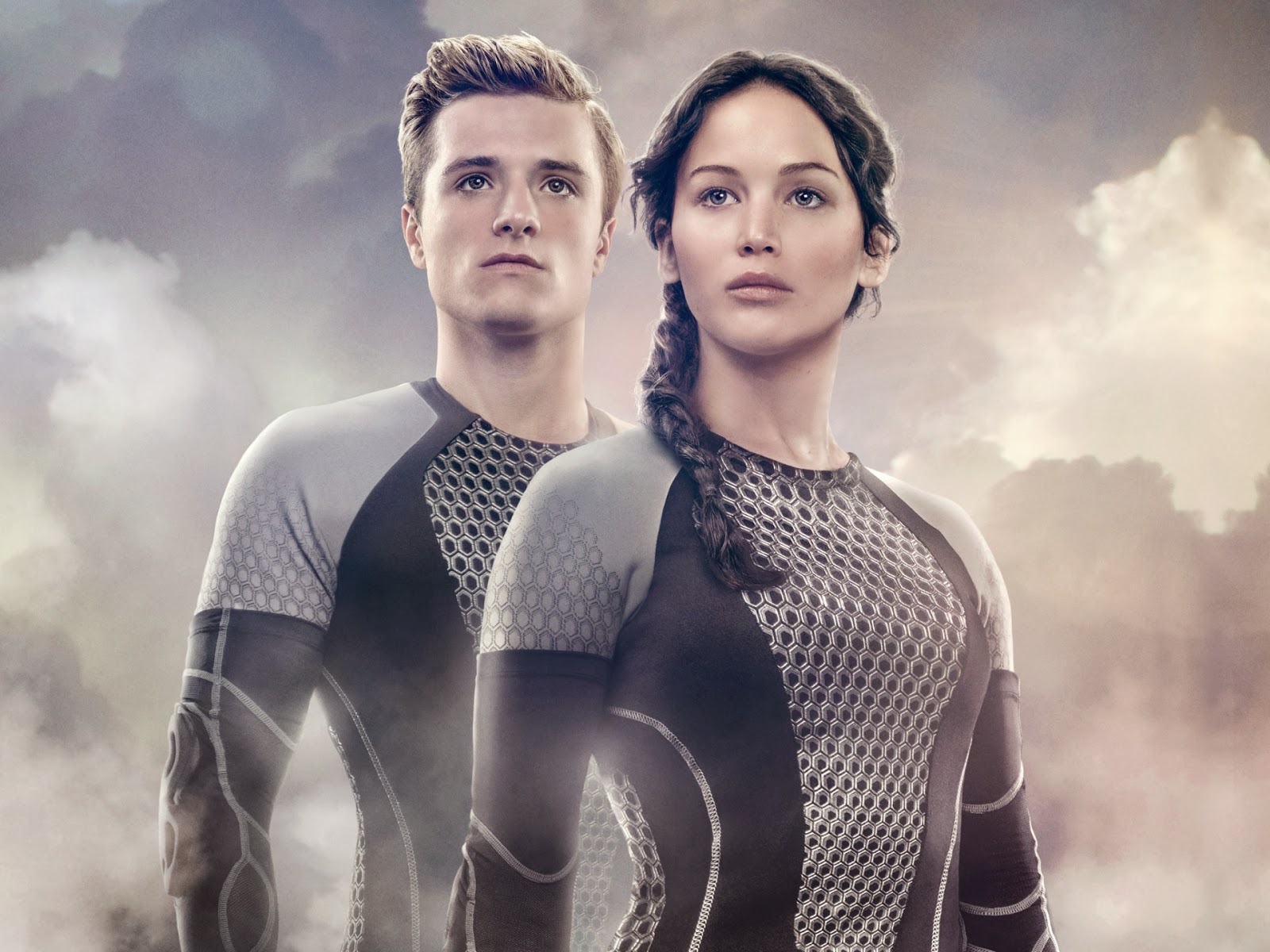
Last time we saw her, Katniss Everdeen was making her triumphant return home after miraculously surviving the kid-killing arena. But it wouldn't be a teen franchise if she wasn't back for more and this time, everyone has grown up. The second film in the Hunger Games trilogy is more fast-paced and frantic than its predecessor. It also seems less preoccupied with its dubious morality and is happy to chug along on the energy of the action.
All in all, this works in its favour and generally makes for better entertainment. Jennifer Lawrence resumes her role as Katniss, managing to make a character that could easily be another Bella Swan both powerful and sympathetic. This time, she's being forced to face up to the consequences of survival. Having escaped the arena with her (supposed) lover Peeta (Josh Hutcherson), while her real boyfriend Gale (Liam Hemsworth) languishes at home, she is trapped between her loyalty to the revolutionary spirit of her people and fear of what the tyrannical President Snow might do in retaliation.
Unluckily for her, his revenge is brutal: he decides to stage a 75th Hunger Games that reaps its participants from the existing pool of victors. So she and Peeta, after a lacklustre performance as star-crossed lovers, are back where they started. But now, their opponents are older, faster and smarter, and the arena has been transformed into a punishing tropical prison.
It's easy to be dismissive of the young adult franchise but The Hunger Games is definitely a lot better than its vampiric counterpart. The series has a real star in Lawrence, and Elizabeth Banks and Woody Harrelson provide excellent comic support as Effie and Haymitch. There are a couple of scenes that don't really ring true: the dynamic between Katniss and her family is a bit stale, and the love triangle doesn't work, mainly because Gale seems like a leading man forced into the wings, and Peeta is just quite annoying. Nonetheless, it's riveting stuff, and I really wish they'd hurry up and make the next one.
Also, was going to leave a link to the trailer but I'm sure everyone has seen it and this is much funnier…
Uncompromising, visceral; difficult to watch: these are all terms that could apply to this astonishing and brutal film. And it's supposed to be a romance. It was hard to know what to expect from Abdellatif Kechiche's Blue is the Warmest Colour. Its glory at Cannes, where it won the coveted Palme d'Or, was marred by the fallout of its cast and crew. Lead actresses Léa Seydoux and Adèle Exarchopoulos claimed in interviews that their experiences on set had been unbearable, alleging that Kechiche had forced them to shoot the famously explicit sex scenes for hours on end. Despite being called to the stage to share the award with their director at Cannes - a tribute to their towering performances - these accusations have cast a shadow over the film's mainstream distribution.
And this is such a terrible pity. Because Blue is the Warmest Colour really does deserve every accolade that comes its way. It is, at heart, a character study: the French title (La Vie d'Adèle Chapitres 1 & 2) more accurately reflects its focus on Exarchopoulos' Adèle whose life we track from teenage sexual awakening to the inevitable loss that comes with maturity. This awakening comes in the form of Emma (Seydoux), an art student whose bright blue crop becomes the locus of the title's symbolism. When Emma stops dyeing her hair, we know it's bad news for their relationship.
Yet in the interval, Kechiche and his two actresses manage to create one of the most intense and convincingly rendered on-screen couples in recent cinema. The way the film is shot has a lot to do with its power: the camera lingers on details - faces, clothing, food - consuming its objects with the same greed we see in Adèle. She is voracious, constantly eating huge bowls of spaghetti; whereas Emma is more refined, preferring oysters. There is a class dynamic in play here but its consequences are perhaps unexpected. Whilst Emma becomes increasingly absorbed in herself and her art, Adele seems to grow into a new maturity, acquiring an understanding of the world she inhabits that eludes her erudite lover.
Adèle Exarchopoulos is simply extraordinary in this role. She is in almost every frame of a film that runs for three hours and gives the performance everything: never have blood, sweat and tears been so literally translated onto the screen. It would be a huge oversight if she doesn't get a golden statue out of this as she makes the efforts of other possible contenders look feeble and staged. Seydoux is equally captivating, playing Emma with the egotistical edge that is both alluring and slightly chilling. A lot of fuss has been made about the sex scenes but, although undoubtedly frank and lengthy, they don't dominate the narrative, which is at its best when dealing with emotional discord: the fight scene and the attempt at reunion.
Blue is the Warmest Colour is exhausting in the best possible way. It demands a lot of its characters and its viewers but it is this refusal to let up that makes it so rewarding. Regardless of the post-production controversy, this is a stunning and shocking account of first, perhaps last, love in all its angry, messy complexity.